The most expensive sentence in small-business marketing is “Let’s just hire someone.” Here’s the buyer’s guide nobody hands you.
I am going to start with the most expensive sentence in small-business marketing, the one I have watched bankrupt good people who deserved better: “Let’s just hire someone to do our marketing.“
It sounds so reasonable. You are a small business — one of roughly 33 to 36 million in the United States alone, making up about 99.9% of all firms — and you are drowning. You are the founder, the head of sales, the person who answers the phone, and somewhere around 9pm you remember you are also supposed to be doing marketing. So you decide to hire help. Sensible. Overdue, even.
And then, more often than not, it goes wrong — not because the help was bad, but because you hired the wrong kind of help for the wrong problem, at the wrong moment, for the wrong reasons. I have been the hired help. I have also been called in to clean up after the previous three hired helps. So let me write the buyer’s guide I wish every small-business owner had taped to their monitor before they ever signed a contract.
First, an uncomfortable mirror
Before we talk about who to hire, we need to talk about why marketing feels broken in the first place, because the answer changes everything.
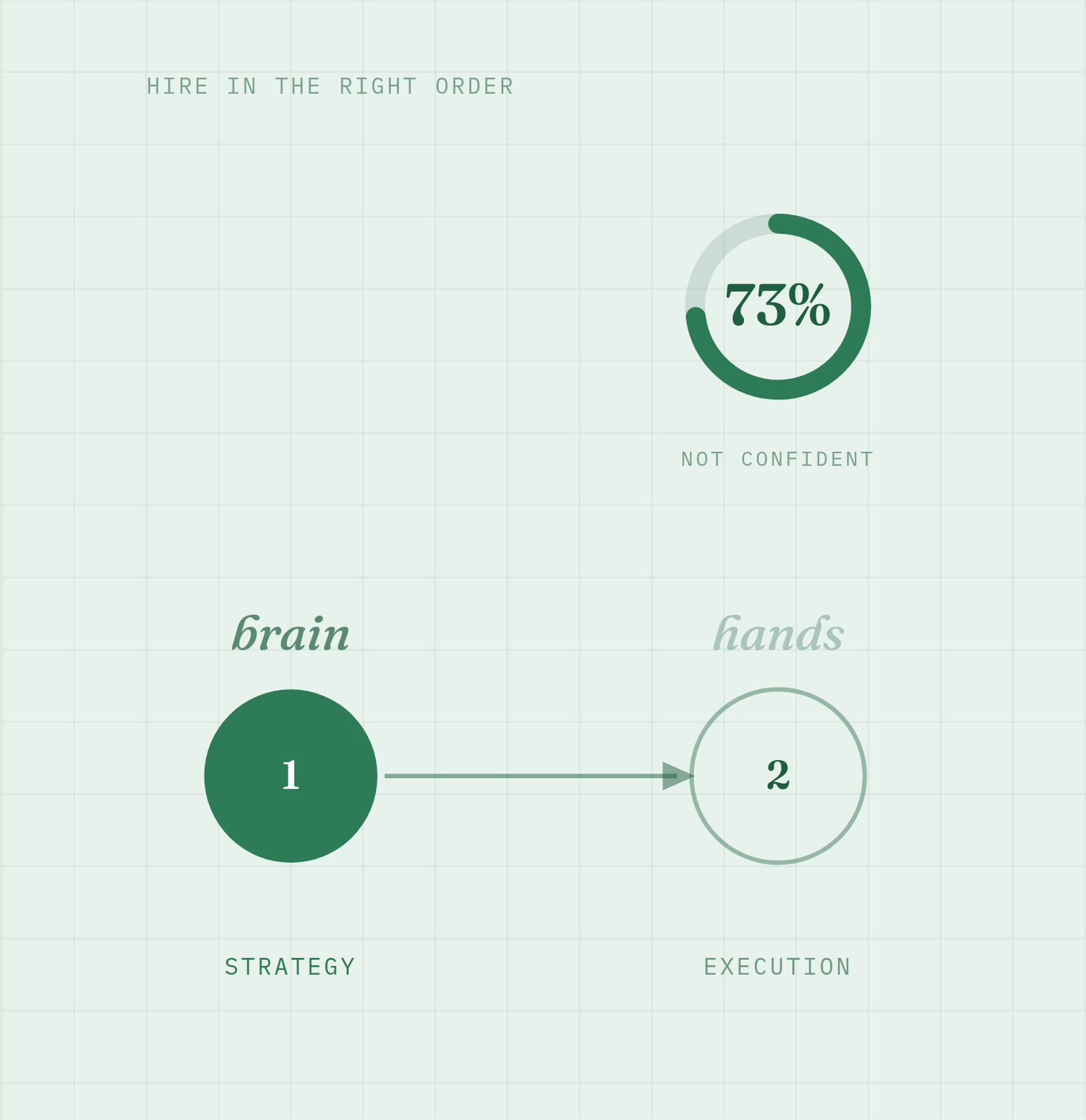
Here is a statistic that should stop you cold: about 73% of small businesses are not confident their marketing is working. Nearly three-quarters. And it is not because they are lazy or stupid — these are capable people running real businesses. It is because most of them are doing marketing without a plan. The data on this is almost embarrassingly stark: businesses with a documented marketing plan are roughly 6.7 times more likely to report success than those operating without one. I have rarely seen a single variable move an outcome that much.
| 6.7×more likely to report success when a business has a documented marketing plan versus operating without one.DOCUMENTED-PLAN STUDIES |
So before you hire anyone, look in the mirror and answer one question honestly: do you have a strategy, or do you just have activity? Because the answer determines whether you need a brain or a pair of hands — and confusing those two is, without exaggeration, the most expensive mistake in small-business marketing.
The single most common (and costly) mistake
Let me name the disaster directly, because it happens constantly and it is entirely avoidable.
A small business with no clear strategy hires a marketing agency — a team built to execute. The agency, reasonably, asks: “Great, what would you like us to do?” The founder, who does not have a marketing background, picks channels based on what competitors appear to be doing. The agency dutifully executes those tactics, because executing is their job and you didn’t give them a strategy to execute against. Three months and a five-figure invoice later, the results are murky, because nobody ever defined what “results” were supposed to mean.
This is so predictable that the matchmaking firm MarketerHire, after tens of thousands of placements, found that companies who hire agencies without a strategic leader in place tend to churn through two or three agencies in eighteen months. Read that carefully: they don’t fix the problem by switching agencies, because the agency was never the problem. As the firm put it, the brief is the problem. Nobody is writing a good one. You can change the construction crew as many times as you like — if there are no blueprints, the house still won’t stand.
| 2–3agencies churned through in 18 months when firms hire execution without a strategic leader. The brief was the problem.MARKETERHIRE PLACEMENT DATA |
You can change the construction crew as many times as you like — if there are no blueprints, the house still won’t stand.
There is a brutal little phrase for the version of this where you do have some data: hiring an agency without independent strategy means you end up “grading the agency’s homework with the agency’s answer key.” They report the metrics that make them look good — impressions, reach, engagement — and you have no independent way to know whether any of it touched revenue. The metrics go up. The bank account does not. Everyone is confused and slightly resentful.
So: strategy first, execution second. Hire a brain before you hire hands. If you cannot articulate your top three marketing priorities for the next quarter, an agency will not fill that gap — it will just bill you while you fail to fill it yourself.
The four kinds of help, and what each is actually for
Let me demystify the menu, because the job titles are deliberately confusing and the pricing is all over the map.
The freelancer / specialist is a pair of expert hands for one defined job — running your paid search, writing your content, managing your email. They are affordable and flexible, and they are wonderful when you already know what you want done. They will not own your strategy; expecting them to set your direction is asking a sprinter to also be the coach. For many genuinely small businesses — especially anyone spending under roughly $10,000 a month on marketing — a single good specialist focused on the one channel that matters is more efficient than either a fancy strategist or a full agency. Most small businesses do not need an orchestra. They need one excellent violinist and a clear piece of music.
The agency is a team — designers, media buyers, SEO people, copywriters — built for scaled execution and production capacity. If you need twenty blog posts a month, a paid campaign across three channels, and a social programme running simultaneously, an agency has the muscle. What an agency is not built to do, despite what the sales call implies, is own your company-level strategy. Most agencies will not challenge your positioning, question whether you are even targeting the right customer, or tell you that your whole channel choice is wrong — because they were hired to execute, and because, frankly, it is awkward to talk a client out of the work they are paying you for. Agencies typically run $10,000 a month and up, often plus media spend.
The fractional CMO is a senior strategist who works part-time across several clients. They own the “what” and the “why” — your positioning, your ideal customer, your channel priorities, your measurement framework — and then they direct the freelancers or agency who do the “how.” They typically cost somewhere around $3,000 to $15,000 a month, a fraction of a full-time marketing executive’s salary. This is the right answer when your marketing feels random, when nobody can explain your value in thirty seconds, or when you, the founder, are spending more than a fifth of your time managing marketing vendors instead of running your company.
The consultant / advisor is the lightest touch — high-level guidance, usually a call a week, strategy and structure help, often without hands-on execution. Great for unblocking you when you mostly know what you’re doing but need an experienced sounding board.
A small, sarcastic warning about titles
Now let me protect you from a specific 2026 phenomenon, because the market has a new favourite costume.
“Fractional CMO” has become the trendy title, which means — inevitably — that a great many people who were a content marketing manager at one startup eighteen months ago are now billing themselves as fractional CMOs, because it sounds considerably better than “freelancer.” Buyer beware. A true fractional CMO must actually be qualified enough to be a CMO of a business like yours. The genuinely senior ones, amusingly, often don’t even use the term — they quietly call themselves advisors. So do not be hypnotised by the title on the LinkedIn banner. Ask what they have actually owned, and what number they were actually accountable for. A grand title on a thin résumé is not strategy. It is marketing — applied, ironically, to the marketer.
The questions that cut through everything
When a small-business owner asks me how to choose, I do not give them a vendor list. I give them questions to ask themselves, because the right hire falls out of honest answers almost automatically.
– Can you state your top three marketing priorities for this quarter? If no, you have a strategy gap, and no amount of execution will close it. Get a brain first.
– Do you know which channel produces your best cost per acquisition? If no, you need someone to build measurement before you spend another dollar amplifying things you can’t evaluate.
– Have you churned through two or more agencies or freelancers in the last eighteen months? If yes, the problem is almost certainly upstream of execution. The brief, the targeting, or the channel choice was wrong. Stop firing the crew and go fix the blueprints.
– Can anyone on your side evaluate a vendor’s performance independently? If no, you are grading their homework with their answer key. Fix that before you sign.
– What is your actual monthly budget? Under ~$10k, lean toward one sharp specialist. More than that, with a strategy gap, lean toward a fractional strategist who can then direct execution.
And the single most clarifying question of all, the one I save for last because it reframes everything: who is responsible for saying no? If nobody in your marketing setup can kill a bad campaign, reset priorities, or push back on a wishful idea from leadership, then you do not have a strategy owner. You have activity with an invoice attached. Find the person who can say no, and you have found the person worth hiring.
The single most clarifying question of all: who is responsible for saying no?
Match the help to your stage, not to the hype
One more lens, because the right answer genuinely changes depending on where your business is standing, and a lot of grief comes from hiring for a stage you are not at yet.
If you are very early — pre-revenue, still figuring out who your customer even is — you probably need neither an agency nor a strategist. Brace yourself, because this is unpopular advice: at this stage the founder should be doing the marketing. You should be talking to customers directly, running scrappy little experiments, and learning what marketing even looks like for your specific product, because nobody else can learn that for you. If you spend at all, spend on one focused freelancer running one channel. Hiring a fancy strategist before you have any data is paying a brilliant navigator to chart a route across a map you haven’t drawn yet.
Once you have real revenue and some genuine signal — customers who repeat, a channel that seems to work, a budget worth steering — that is when a strategist earns their fee many times over. The classic, expensive error at this stage is hiring the execution muscle before the strategic brain: the founder, with no marketing background, picks channels by copying competitors, the agency executes them faithfully, and thirty thousand dollars later nobody can say whether it worked because nobody defined “worked.” A strategist prevents precisely this by building the measurement framework first, so that every dollar after it can actually be judged.
And here is the model that quietly wins for most growing small businesses: the hybrid. A strategist owns the direction — positioning, customer, priorities, the definition of success — and then a focused agency or a couple of specialists execute against that direction under the strategist’s accountability. Think of the strategist as the general contractor and the specialists as the trades. The trades are brilliant at their craft; the contractor makes sure they are all building the same house. A useful trigger for reaching for this model: if you, the owner, are spending more than about a fifth of your time coordinating freelancers and squinting at campaign reports instead of running your company, you have outgrown the do-it-yourself stage and it is time to hand the coordination to someone whose actual job that is.
A final word on money, because I know it is the elephant. Small businesses are tight on it — many firms with ten or fewer employees run on marketing budgets under $500 a month — and the temptation is always to choose the cheapest option and hope.
But marketing leadership is an investment, not a cost to be minimised, and “cheap” has a way of becoming the most expensive line in the budget. The cut-rate hire who executes the wrong tactics enthusiastically does not save you money; they spend your scarce budget faster, on the wrong things, while burning the most irreplaceable resource you have — time you will never get back, and a market position you may not get a second shot at. I would rather see a small business spend less, but spend it against a clear plan, than spend more spraying it across rented platforms with no one steering. A modest budget aimed by a real strategy beats a larger budget with no aim, every single time.
The honest bottom line
Smaller businesses absolutely need marketing — that part was never in doubt. About 61% of small businesses haven’t even invested in SEO, seven in ten small-business websites don’t have a clear call to action, and the cost of acquiring a customer has roughly tripled in a decade. The need is real and the stakes are rising. But “needing marketing” and “hiring marketing” are two different sentences, and the gap between them is where good businesses quietly lose money.
So before you sign anything, do the unglamorous work: figure out whether your problem is strategy or execution, hire the brain before the hands, be suspicious of trendy titles, ask who is allowed to say no, and refuse to mistake cheap for affordable. Do that, and the right help becomes the best money you ever spend. Skip it, and you will join the 73% who pay for marketing and quietly suspect it isn’t working — because, hired in the wrong order for the wrong reasons, it usually isn’t.
| 73%of small businesses are not confident their marketing is working. Usually the cause is activity without a plan.SMALL-BUSINESS MARKETING SURVEY |
Choose the brain. Then choose the hands. In that order. Everything else is just expensive guessing. ■