The modern library isn’t a quiet building made of stone and wood anymore; it is a glowing screen filled with infinite possibilities and even more distractions. For today’s students, the greatest threat to a high-distinction grade isn’t a lack of intelligence or a difficult syllabus. Instead, it is the silent erosion of time caused by “micro-distractions.” You know the feeling: you sit down to dive into a deep research paper, and a notification pings. It’s just a quick text. You reply, look back at your screen, and suddenly, the complex thread of thought you were holding has vanished. This constant “context switching” is fundamentally changing how brains process academic information.
The danger of a quick 15-minute break is that it’s never actually just 15 minutes. Science tells us about a concept called “attention residue.” This means that when you switch from your thesis to a social feed, a part of your brain stays stuck on that last post even after you start writing again. It takes the average person nearly 20 minutes to fully regain deep focus after a single interruption. If you are constantly losing your place, it might be time to look for online assignment help at myassignmenthelp to bridge the gap between your research goals and the reality of a fractured schedule. By getting a solid structural foundation for your work, you can stop the cycle of starting from scratch every time your phone pings.
The Science of Fragmented Focus
When we study in short bursts interrupted by pings, we aren’t just losing time; we are losing quality. Research requires “Linear Thinking”—the ability to follow a complex idea from its premise to its conclusion. Micro-distractions force us into “Non-Linear Thinking,” where our brain only captures surface-level facts. This is why many students find themselves reading the same paragraph five times without actually understanding it. The brain is effectively hitting a “reset” button every time focus is broken, leading to neural fatigue that makes the actual writing process feel twice as hard as it should be.
How Digital Burnout Dilutes Your Grades
The mental cost of these distractions is massive. We often think of burnout as working too hard for too long, but in 2026, burnout is more often caused by the stress of “unfinished business.” Every time you get distracted, your brain registers a task as “incomplete,” which creates a background hum of anxiety. This anxiety makes the next study session even harder to start. To break this loop, many high-performing students work with an assignment expert to handle the heavy lifting of data organization and formatting. This allows the student to focus on the core learning without getting bogged down by the administrative weight of a 5,000-word paper.
Breaking the Loop: Reclaiming the Deep Work Zone
To fight back against the 15-minute trap, students need to move toward “Digital Minimalism.” This isn’t about throwing your phone away; it’s about building a fortress around your study time. High-quality research isn’t born in the moments between TikTok scrolls; it’s born in the second hour of uninterrupted thought.
1. The Cost of “Context Switching” in 2026
In the tech world, “context switching” refers to a computer jumping between different programs. Humans are much worse at this than computers. When you jump from a scholarly journal to a group chat, your brain’s “RAM” gets cluttered. This clutter slows down your ability to synthesize information, which is the heart of good research. If you can’t synthesize, you can’t create original arguments, leaving your essays feeling thin and superficial.
2. Notification Fatigue and the Dopamine Trap
Every notification provides a tiny hit of dopamine. Compared to the hard, slow work of academic research, a “Like” or a “Comment” feels much better to our brains. We have become addicted to the quick win. Academic research, however, is a “Delayed Gratification” activity. You don’t get the reward until the paper is finished. When these two worlds collide, the quick win usually wins, leaving the student with a half-finished essay and a rising sense of panic as the deadline approaches.
3. Strategies for Intent-Driven Study
The best way to combat micro-distractions is to set “Intent Gates.” Before you open your laptop, decide exactly what one thing you will accomplish. For example: “I will find three primary sources for my introduction.” Don’t allow yourself to open a single tab that isn’t related to that goal. By narrowing your field of vision, you reduce the opportunities for micro-distractions to take hold.
4. The Role of Structural Support in Modern Education
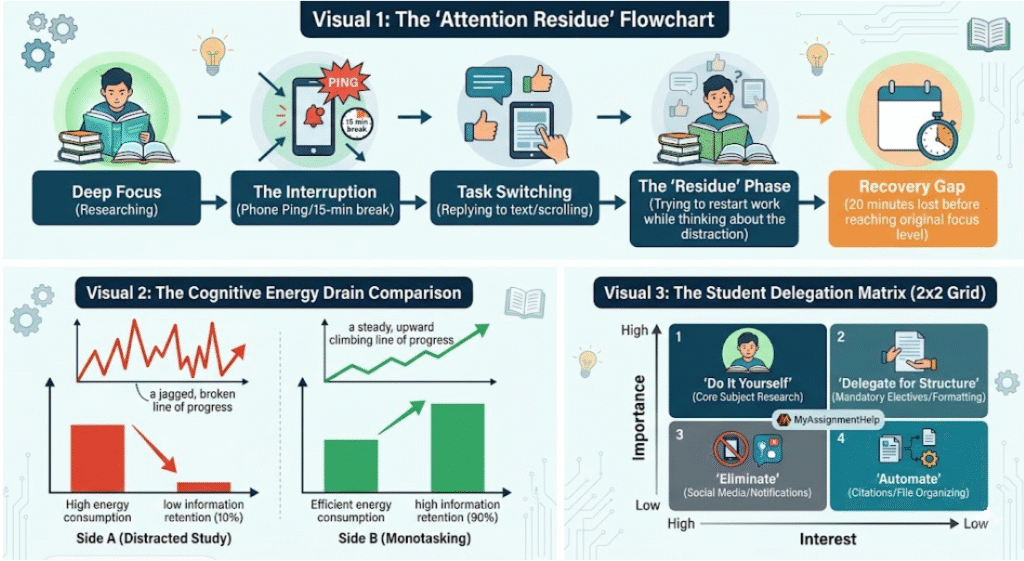
In a world that is designed to distract us, sometimes the most responsible thing a student can do is delegate. High-level academic success in 2026 isn’t just about how much you know; it’s about how well you manage your resources. Utilizing expert support isn’t a sign of weakness—it’s a tactical move to ensure that your academic record reflects your true potential, rather than just your ability to resist your smartphone.
The Delegation Matrix: A Student’s Guide
| Task Type | The Struggle | The Solution |
| Brainstorming | Creative blocks due to stress. | Mind-mapping and peer review. |
| Data Gathering | Getting lost in endless tabs. | Curated research databases. |
| Structural Formatting | Wasting hours on citations. | Professional formatting services. |
| Drafting | The “Blank Page” syndrome. | Model papers and outlines. |
Why Depth Always Beats Speed
Google’s search algorithms and university professors have one thing in common: they both value Depth. A shallow paper written in 15-minute bursts is easy to spot. It lacks a “voice” and fails to connect different ideas. On the other hand, a paper written in a state of “Flow” has a rhythm and a logical progression that is impossible to fake. When you protect your time, you protect the value of your degree.
Practical Tips to Silence the Noise
- The Airplane Mode Rule: If you are researching, your phone shouldn’t just be on silent; it should be disconnected.
- Single-Tab Method: Use a browser extension that limits you to one or two open tabs at a time.
- Monotasking: Stop believing the myth of multitasking. It doesn’t exist. You are just doing multiple things poorly.
- The “Parking Lot” Technique: If a random thought or “to-do” item pops into your head during research, write it on a physical notepad (the “parking lot”) and deal with it later.
Final Thoughts: Building a Resilient Mindset
The battle for your attention is the biggest challenge of the digital age. By understanding the science of micro-distractions, you can start to build habits that protect your focus. Whether it’s through stricter digital habits or by leveraging professional support to manage your workload, the goal is the same: to ensure that your research is a true reflection of your intellectual capability.
Don’t let a 15-minute distraction become a lifetime of “what if.” Take control of your workflow, set your boundaries, and remember that deep work is the only work that truly changes the world. Academic excellence is a marathon, not a series of sprints between notifications. When you prioritize your mental clarity, the grades will naturally follow.
Frequently Asked Questions
- What exactly is attention residue?
Attention residue occurs when your brain remains partially focused on a previous distraction, such as a social media post or text message, even after you have returned to your primary task. This mental “clutter” prevents you from reaching the level of deep focus required for complex research. - How long does it take to recover focus after a distraction?
On average, it takes approximately 20 minutes to fully regain a state of deep concentration after a single interruption. Even a “quick” five-minute break can lead to a significant loss in total productivity due to this recovery gap. - Why does multitasking feel more exhausting than focused work?
Constantly switching between different activities uses up a limited supply of “executive function,” the part of the brain responsible for willpower and decision-making. This rapid context switching leads to neural fatigue, making you feel burned out even if you haven’t finished your work. - Can digital habits improve research quality?
Yes, by practicing digital minimalism and setting strict boundaries—such as using airplane mode or single-tab browsing—you protect your brain’s ability to engage in “linear thinking”. This leads to deeper arguments and a more logical flow in your final writing.
About The Author
Min Seow is a dedicated contributor to the MyAssignmentHelp team, where she focuses on creating insightful content that bridges the gap between complex academic requirements and practical student success. With a background in educational strategy, she is committed to helping learners worldwide achieve their goals through clear and authoritative guidance.